Knowing what to consider before buying furniture for a small home can prevent expensive mistakes and make everyday life feel noticeably easier. A beautiful sofa that blocks the hallway or a dining table that leaves no room to pull out chairs quickly becomes a source of frustration.
The best choices usually combine accurate measurements, suitable furniture scale, useful storage, and more than one function. By assessing your apartment layout before shopping, you can create a home that feels open, comfortable, and personal without giving up the pieces you genuinely enjoy.
Start With Measurements, Not Shopping
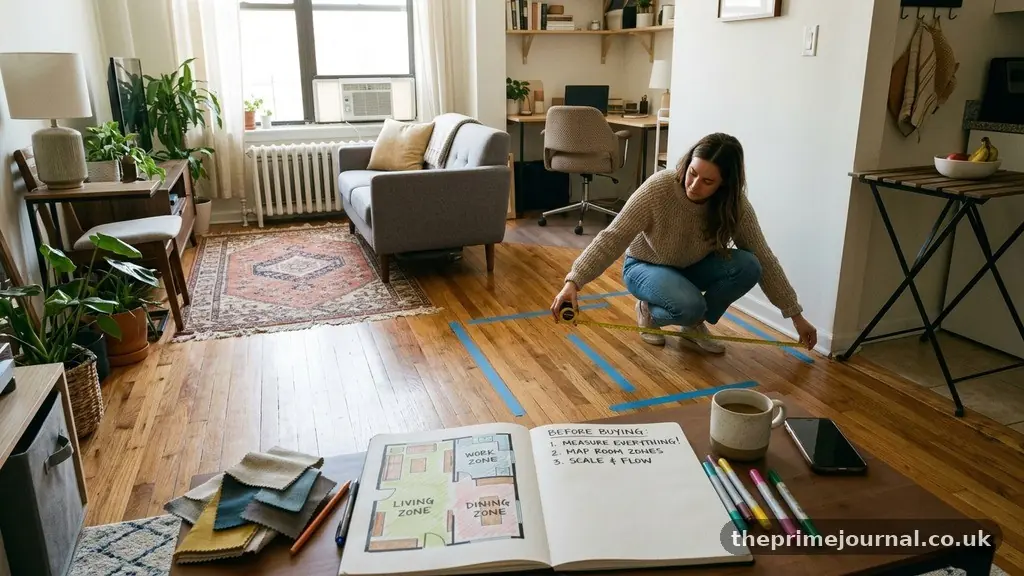
The first answer to what to consider before buying furniture for a small home is simple: measure the space and the route into it before looking at products. Record the length and width of each room, ceiling height, door openings, window positions, radiator locations, electrical outlets, and any built-in features that cannot move.
Room dimensions tell only part of the story. Measure the elevator, stairwell, building entrance, corridor turns, and apartment door as well, because a cabinet that fits the living room may still be impossible to deliver.
Create a basic floor plan on paper or in a room-planning app. Mark doors with their full swing, windows with their sill height, and fixed heating or ventilation features so you don’t accidentally plan furniture across them.
Use painter’s tape on the floor to outline a prospective sofa, bed, or dining table. This gives you a physical sense of its footprint and shows whether the remaining space supports comfortable movement.
Before buying, write down three figures for every major item: the assembled dimensions, the package dimensions, and the minimum delivery clearance. Product pages often show only the first measurement, yet the other two can determine whether the purchase works at all.
- Room measurements: note wall lengths, ceiling height, doors, windows, radiators, and outlets.
- Access measurements: check entrances, stairs, lifts, corridors, and tight corners.
- Clearance measurements: allow space for doors, drawers, recliners, and chairs to operate.
- Placement measurements: mark rugs, lamps, vents, and walking routes before ordering.
- Product measurements: compare assembled size with boxed size and delivery requirements.
A small home benefits from precision because every inch has a job. Spending fifteen minutes with a tape measure can save the cost, hassle, and environmental waste of returning a large item that never belonged in the room.
Match Furniture Scale to the Apartment
Furniture scale is different from simple size. Two sofas can have the same width, but one may feel much heavier because it has deep cushions, thick arms, a low base, and a dark solid frame.
For a compact living room, compare seat depth as carefully as overall width. A sofa that is 85 inches wide but 40 inches deep may occupy far more usable floor area than a slimmer design with a 32-inch depth.
Raised legs can make a substantial piece appear lighter by allowing the eye to see more floor beneath it. Open arms, exposed frames, and pale upholstery can also reduce visual weight, although durability and maintenance still matter if the furniture will receive heavy use.
Don’t assume that buying the smallest available item is the best answer. A tiny loveseat may leave two adults uncomfortable, while a properly proportioned compact sofa could provide better seating and prevent the room from filling with extra chairs.
Think about height as well as width. A tall bookcase can use vertical space efficiently, but a high-backed sofa placed beneath a low window may make the room feel crowded and reduce natural light.
| Furniture choice | Potential benefit | Possible small-room problem | What to check |
|---|---|---|---|
| Deep sectional sofa | Seats several people | Consumes floor area and may restrict traffic flow | Depth, corner width, and doorway access |
| Armless lounge chair | Provides seating with less visual bulk | May offer less support or comfort | Seat height, back support, and daily use |
| Tall shelving unit | Uses vertical storage | Can dominate a narrow wall | Anti-tip fittings, ceiling clearance, and depth |
| Glass or open-base table | Preserves a sense of openness | May show fingerprints or feel less child-friendly | Safety, stability, and cleaning needs |
Use a visual balance test before committing. If one large piece occupies most of the wall and every other item must be squeezed around it, choose a simpler form or a narrower version rather than trying to compensate with more decorations.
Protect Traffic Flow and Furniture Clearance
A small room works well only when people can move through it without repeatedly turning sideways or bumping into corners. Traffic flow should guide the arrangement before style enters the discussion.
Identify the main routes first: the path from the entrance to the kitchen, the route to the balcony or window, and the way from the bed to the bathroom or wardrobe. Keep those routes visually and physically clear.
Furniture clearance also includes the space required to use an object. A dining chair needs room to slide backward, a wardrobe door needs a full opening arc, and a sofa bed needs an empty area in front of it when extended.
Exact clearance needs vary by furniture type and household, so use the manufacturer’s recommendations where they exist. As a practical planning habit, leave enough room for a person to walk comfortably past furniture rather than relying on a narrow gap that works only when nobody is carrying laundry or groceries.
Open-plan apartments need special care because one piece often serves as a boundary. The back of a sofa can divide living and dining areas, but it should not create a dead-end corridor or block the easiest route through the home.
Plan the room in zones
Give each area a clear purpose: conversation, work, eating, sleeping, or storage. A compact desk near an outlet can define a work zone, while a rug and two chairs can establish a sitting area without adding a bulky room divider.
Leave doors and drawers usable at the same time. A chest of drawers that opens only after the bedroom door is closed may technically fit, but it creates a daily inconvenience that a slightly narrower unit would avoid.
Place frequently used items closest to where they are needed. Shoes belong near the entrance, cookware near the kitchen worktop, and charging furniture near power outlets rather than across the room.
Prioritise Multifunctional Furniture
Multifunctional furniture earns its place by solving more than one problem without becoming difficult to use. A sofa bed can provide everyday seating and occasional guest accommodation, while an ottoman with internal storage can act as a footrest, spare seat, and container.
Look past product labels and test the actual transformation. A sofa bed should open smoothly, fit the available clearance, and offer a sleeping surface that suits the guest rather than functioning as an emergency option nobody wants to use.
An extendable dining table can remain compact for daily meals and accommodate visitors when needed. Check the table’s full length, the number of chairs it requires, and whether the extension leaf needs separate storage.
Nesting tables are useful because smaller surfaces can tuck beneath a larger one when they are not needed. They work especially well beside a sofa, where one table can hold a lamp and the others can come out for drinks or snacks.
Modular furniture offers another form of flexibility. A sectional with movable pieces can adapt to a future move, while stackable stools can serve as seating, side tables, or occasional bedside surfaces.
Flexibility has limits, though. A desk that folds into a wall may save space, but it becomes a poor purchase if setting it up every morning requires moving three objects first.
- Choose a sofa bed when overnight guests are regular enough to justify the floor space and conversion effort.
- Choose an extendable dining table when daily use is compact but hosting is part of your routine.
- Choose nesting tables when you need flexible surfaces but have little room for several separate tables.
- Choose modular furniture when your apartment layout may change or you expect to move.
- Choose wall-mounted furniture when the wall is structurally suitable and keeping the floor clear has a real benefit.
Ask one useful question: will this second function be used at least several times a month? If not, a simpler, more comfortable primary-use item may be the better investment.
Use Storage Without Making the Room Feel Full
Storage is often the deciding factor in a small home, but adding cabinets everywhere can make the apartment feel compressed. The strongest approach combines built-in storage, movable pieces, and unused vertical areas.
Look for furniture that stores items close to the point of use. A bed with drawers can hold seasonal clothes, a media console can conceal cables and devices, and an entry bench can hide shoes while providing a place to sit.
Vertical storage makes use of wall height rather than consuming more floor area. Tall shelving, narrow cabinets, and wall-mounted furniture can keep books, cleaning supplies, or kitchen equipment organised while preserving open floor space below.
Secure tall units properly, especially in homes with children, pets, or frequent activity. The U.S. Consumer Product Safety Commission’s furniture tip-over safety guidance explains why anchoring storage furniture matters and what households should check.
Storage furniture needs internal planning, not just attractive doors. Measure the objects you actually own, including vacuum cleaners, folded blankets, files, shoes, and small appliances, then compare those needs with shelf spacing and drawer depth.
Choose closed and open storage deliberately
Open shelving keeps everyday items visible and easy to reach, but it can look cluttered quickly. Closed storage creates a calmer appearance and protects belongings from dust, although it needs enough internal capacity to justify its footprint.
Use open shelves for attractive or frequently handled pieces, such as books, plants, and a small speaker. Hide irregular objects, spare cables, paperwork, and cleaning supplies behind doors or in labelled boxes.
Don’t buy storage with excessive depth merely because it holds more. Deep shelves often create a second hidden row of objects, making the back space hard to reach and encouraging forgotten clutter.
A useful storage system should reduce decisions. If every item has a sensible home and the container is close by, tidying takes less time and the room stays usable between larger cleaning sessions.
Consider Comfort, Construction, and Everyday Use
Small-space furniture still needs to be comfortable enough for real life. A compact chair that looks elegant in a photograph is not a good choice if its seat is too shallow for reading or its arms make it awkward to stand.
Test seating in person whenever possible. Sit for several minutes, check whether your feet rest comfortably on the floor, and notice whether the back supports the posture you use most often.
Inspect construction details that photographs can hide. Look for reinforced joints, smooth drawer runners, stable legs, removable covers, and a frame appropriate for the expected level of use.
Materials should match the household. Performance upholstery may be easier to maintain in a home with children, while a smooth timber or metal finish could be preferable for a piece that receives frequent handling.
Think about cleaning access before buying. A sofa that sits directly on the floor may trap dust underneath, and a heavy bookcase that cannot be moved may complicate repairs or deep cleaning.
Balance price with replacement risk
The lowest purchase price is not always the lowest cost over time. A flimsy table that needs replacement after a short period can cost more than a sturdy, repairable design that remains useful through several apartment layouts.
Set a budget by priority rather than spreading the same amount across every item. Spend more on a mattress, primary sofa, or desk chair if those pieces support daily sleep, work, or comfort, and choose simpler options for occasional-use tables.
Check warranties, return conditions, spare-part availability, and delivery fees before ordering. A low-priced item can become expensive after assembly charges, stair-carry fees, or a return policy that excludes opened furniture.
Second-hand furniture can work well in a small home if dimensions and condition are verified. Ask for measurements, inspect drawers and joints, and confirm that the item can be dismantled or transported through your building.
Choose a Style That Supports Space
Style should make the home feel like yours, but certain visual choices can help a compact room feel calmer. Repeating a limited palette across upholstery, rugs, and storage creates continuity instead of making every object compete for attention.
Light does not require an all-white interior. Pale timber, soft grey, muted green, warm beige, and reflective metal can all support brightness while adding character.
Furniture with exposed legs often creates more visual breathing room than heavy plinth-based pieces. That said, a closed base may be useful when you need hidden storage, so choose based on function rather than following a rule mechanically.
Use texture instead of too many small decorative objects. A woven throw, a patterned cushion, or a textured rug can add warmth without consuming the surfaces needed for daily tasks.
Consider how new furniture will relate to what you already own. A new table may be technically attractive but still feel wrong if its proportions, wood tone, or finish clashes with the existing floor and cabinetry.
Scale matters in decoration too. Several tiny pictures scattered across a wall can create visual noise, while one appropriately sized artwork may provide a stronger focal point without taking up floor space.
Plan Delivery, Assembly, and Future Changes
Buying furniture is not finished when the order is placed. Delivery, assembly, packaging removal, and future rearrangement all affect whether a piece remains practical in a small home.
Confirm the delivery date and the item’s arrival condition before clearing the room. Photograph visible damage immediately, keep packaging until you’ve checked the furniture, and read the retailer’s instructions for reporting defects.
Choose pieces that can be assembled inside the apartment if access is tight. A large preassembled wardrobe may be more difficult to install than a flat-packed version, even if the finished dimensions are identical.
Plan where packaging will go. Cardboard, protective foam, and plastic can occupy a surprising amount of space in a small apartment, especially when several deliveries arrive during a move.
Think about your next two years, not only today. If you may move, change jobs, share the home with a partner, or need a nursery, modular furniture and adaptable storage can prevent a second expensive buying cycle.
Leave a little flexibility in the room rather than filling every available corner. Empty space is useful for stretching, exercising, opening luggage, hosting guests, or simply making the home feel less pressured.
Questions Shoppers Commonly Ask
What furniture should be bought first for a small home?
Start with items that support essential daily activities: a mattress, seating, a work surface if needed, and practical storage near the entrance. Buy them in relation to one another so the largest piece does not consume the floor area required by everything else.
Is a sectional sofa a bad choice for a compact living room?
Not necessarily. A sectional can provide efficient seating, but check its total depth, corner shape, delivery route, and whether the chaise blocks a doorway or creates a poor traffic flow.
How much clearance should be left around furniture?
There is no single number that suits every room or furniture type. Leave enough room for the intended action, such as walking, pulling out a chair, opening a drawer, or unfolding a sofa bed, and use the manufacturer’s clearance guidance where available.
Are multifunctional pieces always better?
No. They are valuable when both functions are used regularly and the conversion is easy, but a complicated item can waste space if its second purpose is rarely needed. Comfort, reliability, and daily convenience should remain the priority.
Should small homes use mostly light-coloured furniture?
Light colours can reflect more light and reduce visual heaviness, but they are not mandatory. Open bases, suitable scale, uncluttered surfaces, and a consistent palette often matter more than choosing pale furniture for every room.
Make Each Purchase Earn Its Place
What to consider before buying furniture for a small home comes down to a practical sequence: measure the room and access route, protect traffic flow, choose suitable scale, and select storage or flexibility only where it genuinely helps. Comfort and construction deserve as much attention as appearance.
Before ordering, tape the footprint on the floor, verify the delivery dimensions, and imagine using the furniture during a busy morning rather than an idealised photograph. A few careful decisions can turn limited square footage into a home that feels generous, organised, and welcoming.