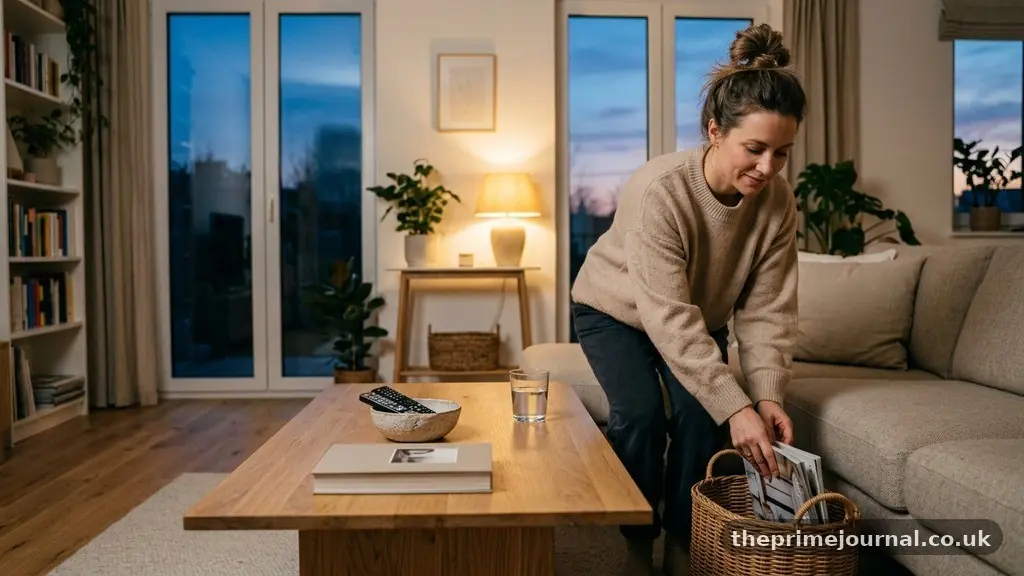
Creating a Calmer Home Without Buying New Furniture starts with changing what you already own, not adding another item to the room. A crowded surface, awkward furniture arrangement, harsh light, or unfinished household task can make a familiar space feel surprisingly demanding.
The good news is that calm often comes from subtraction, repositioning, and small sensory changes. You’ll find practical ways to reduce visual noise, improve natural light, soften busy rooms, and build mindful home habits that make your existing furniture feel more comfortable.
Start With the Changes That Matter Most
The fastest route to a calmer home is usually removing excess, improving movement, and controlling sensory distractions. You don’t need a minimalist home with empty shelves; you need rooms where the eye can rest and the body can move without constantly adjusting to clutter.
Begin with one room and identify the detail that creates the most friction. It might be a chair covered in laundry, a coffee table filled with unopened post, a television that dominates the room, or a walkway narrowed by baskets and side tables.
Clear that pressure point first. A single open pathway or an uncluttered landing spot near the entrance can change how the whole home feels because it removes a repeated irritation from your daily routine.
Use this order when you’re unsure where to begin:
- Remove obvious rubbish and items that belong elsewhere.
- Clear the most visible horizontal surface.
- Improve the route through the room.
- Adjust the strongest light source.
- Keep only the objects that support the room’s purpose.
These steps work because calm is partly a response to reduced decision-making. If every surface asks you to sort, clean, answer, or put something away, the room keeps your attention even when you’re trying to rest.
Take a quick photograph before you start, then another after each major change. A camera often reveals visual noise more clearly than your eyes do because it flattens the scene and shows which objects compete for attention.
| Area to adjust | Low-cost action | Calming effect |
|---|---|---|
| Entryway | Limit visible shoes, bags, and post | Creates a clearer arrival point |
| Living room | Open the main walking route | Reduces physical and visual congestion |
| Bedroom | Clear the bedside area | Supports a quieter bedtime transition |
| Kitchen | Store infrequently used tools away | Makes routine preparation feel simpler |
Reduce Clutter Without Chasing Perfection
Decluttering becomes less intimidating when you treat it as a decision about access rather than a moral test. The question isn’t whether an object is useful in some distant situation; it’s whether keeping it in this room improves the way you live there.
Work in small zones, such as one drawer, one shelf, or the top of a cabinet. Emptying an entire room can create a temporary mountain of possessions and make the project feel worse before it feels better.
Use four practical categories: keep here, keep elsewhere, donate or recycle, and decide later. The final category should have a limit, such as one box with a review date, so uncertainty doesn’t become another permanent form of clutter.
Visible storage deserves particular attention. Even neatly arranged objects create more visual information than a clear surface, especially when their colours, labels, and shapes vary.
That doesn’t mean hiding everything. Display a small number of meaningful pieces together, then leave breathing room around them so each item has visual separation.
Make surfaces easier to maintain
Give every frequently used surface a job. A console might hold keys and one lamp, while a coffee table might support a book, a remote control, and a small bowl instead of becoming a general-purpose drop zone.
Try a “closing shift” at the end of the day. Spend five minutes returning cups, folding blankets, recycling paper, and moving stray items to their proper rooms.
Containers can help, but buying storage solutions before reducing possessions often turns clutter into better-organised clutter. First decide what genuinely needs to remain accessible, then use a basket, drawer, or existing cabinet to contain that smaller group.
Paper is a common source of low-level stress. Create one temporary inbox for bills, school notices, and documents, and process it at a planned time rather than allowing papers to spread across the dining table.
Digital clutter can also affect the atmosphere. A phone charger, laptop, and several cables left in a relaxation area quietly signal unfinished work, so place technology in one defined station when the room is meant for rest.
Keep personality in the room
A calmer home shouldn’t feel anonymous. Family photographs, handmade objects, travel mementoes, and favourite books can make a room feel grounded, provided they’re edited rather than scattered everywhere.
Choose a few items with emotional weight and group them intentionally. Calm comes from clarity, not from removing every sign that someone lives there.
Change the Room Layout Before Changing the Furniture
Furniture arrangement affects calm because it controls movement, sightlines, and the amount of open space around your body. The same sofa and chairs can feel cramped in one position and generous in another.
Start by observing how people actually use the room. Mark the routes between the door, seating, windows, storage, and any frequently used feature such as a desk or television.
Keep the main walking path obvious. A useful route should not require someone to twist around a coffee table, squeeze behind a chair, or cross directly through another person’s conversation area.
Pull furniture slightly away from walls when the room allows it. Even a modest adjustment can create a more intentional seating arrangement and prevent every piece from looking as though it was pushed aside to make space.
Build a clear focal point
Choose one calm focal point for each room. In a living room, that might be a window, fireplace, artwork, or conversational seating rather than a television placed at the centre by default.
Too many focal points create competition. If a patterned rug, open shelving, large screen, bright artwork, and several plants all demand attention at once, the eye keeps moving instead of settling.
Use existing furniture to support the room’s purpose. Angle chairs toward one another for conversation, place a reading seat near a reliable lamp, and position a desk so the user isn’t facing a high-traffic route.
Test the arrangement in real life
Don’t judge a layout only while standing in the doorway. Sit on the sofa, walk through the room carrying a mug, open cupboards, and check whether drawers and doors can be used without collisions.
Leave the new arrangement in place for at least a day before making another major change. A layout can feel unfamiliar at first, yet function much better once your body adjusts to it.
For a living room, note whether people can see one another without craning their necks. For a bedroom, check whether the bed feels easy to approach and whether clothing can be put away without blocking the route.
Small pieces can be repurposed rather than replaced. A stool can serve as a plant stand, a side table can become a bedside surface, and a seldom-used chair can move to an entryway or bedroom corner if it supports a clear purpose there.
Take measurements before moving heavy items. A quick sketch with door swings, windows, and outlets marked on it can prevent repeated rearranging and show which arrangement gives you the most usable open floor.
Use Light and Colour to Lower the Room’s Intensity
Lighting changes a room’s emotional temperature without changing a single piece of furniture. Harsh overhead light can make a living room feel exposed, while one weak lamp may leave corners gloomy and visually uncertain.
Use layers: natural light during the day, task lighting for specific activities, and softer ambient lighting in the evening. The goal isn’t simply brightness; it’s enough light in the right places without glare.
Open curtains fully during daylight hours and remove objects that block the lower part of a window. Clean glass and lightly edited windowsills can make natural light travel farther into the room.
At night, switch off unnecessary overhead fixtures and use existing lamps at different heights. A lamp on a side table, a floor lamp near a reading chair, and gentle light near a hallway create a calmer transition than one powerful ceiling fitting.
Warm bulbs often feel more restful in bedrooms and living areas, while clearer light may be useful in a kitchen or work zone. Avoid assuming every room needs the same lighting temperature.
Choose a quieter colour relationship
A calming colour palette doesn’t have to mean beige or white. Muted greens, dusty blues, warm clay tones, soft grey, and low-contrast neutrals can all work when the colours relate to one another.
Look at the largest existing surfaces first: walls, curtains, rugs, sofas, and floors. If these already contain several strong colours, reduce competing accents rather than repainting immediately.
Group small objects by colour when possible. A collection of books, ceramics, or cushions can look more settled when similar tones sit together instead of being distributed randomly across the room.
Mirrors can increase the sense of light, but placement matters. A mirror facing a messy work surface simply doubles the visual noise, whereas one reflecting a window or a clear wall can make the room feel more open.
Before buying paint, test the effect of editing. Remove bright accessories, fold patterned throws, and temporarily cover a busy surface with a plain textile. You may discover that the colour problem was actually a clutter problem.
Soften Sound, Texture, and Sensory Overload
Calm is not only visual. Hard floors, bare windows, humming appliances, scratchy fabrics, and constant notifications can create sensory overload even in a tidy room.
Begin with sound. Close internal doors when appropriate, silence alerts, move rattling objects away from speakers, and identify whether a refrigerator, extractor fan, or radiator is producing a persistent background noise.
Soft furnishings can absorb some reverberation. Existing curtains, rugs, blankets, cushions, and upholstered chairs help break up hard surfaces, particularly in rooms with wood, glass, tile, or high ceilings.
Texture layering makes a room feel more settled when it’s restrained. Pair a smooth wooden surface with a woven basket, a cotton throw, or a knitted cushion rather than adding several unrelated patterns.
Choose comfort over decoration in the places your body uses most. A blanket that feels pleasant, a cushion that supports your back, and bedding with a breathable texture can influence rest more than a decorative object that only looks attractive.
Control visual movement
Patterns are not automatically stressful, but many high-contrast patterns close together can keep the eye busy. If a rug is bold, let nearby cushions or curtains be quieter so the room has a visual pause.
Keep screens from becoming the strongest light source after dark. Lower brightness, use a warmer display setting, and place the remote or device in a consistent location so searching doesn’t interrupt the evening.
Consider the view from your usual resting position. If you see a pile of laundry, an overflowing bin, or a stack of work documents from the sofa or bed, change that sightline before making decorative changes.
Bring in Nature Without Filling Every Corner
Biophilic design can be simple: daylight, natural materials, views of greenery, fresh air, and shapes that echo the outdoors. You don’t need a room full of houseplants to benefit from a more natural atmosphere.
Place one healthy plant where you’ll actually see it, such as near a desk, kitchen window, or reading chair. A single thriving plant usually contributes more calm than several neglected ones crowded together.
Choose plants according to the light you have rather than the look you want. A low-light room may suit a tolerant plant, while a bright window can support herbs or foliage that would struggle elsewhere.
Natural materials can also soften a room’s character. Wood, linen, cotton, rattan, stone, and clay introduce varied textures without requiring new furniture.
Use what is already available. A wooden chopping board displayed in a kitchen, a woven basket for blankets, a ceramic bowl for keys, or a linen scarf folded over a lamp table can bring organic texture into the space.
Fresh air matters, too. Opening windows briefly when weather and safety permit can reduce stale odours and make a room feel renewed, particularly after cooking, cleaning, or several hours of closed heating.
Support rest with a gentle sensory rhythm
Try linking natural cues to parts of your day. Open curtains after waking, water plants at a consistent time, and dim lights before bed so the home begins to signal transitions instead of keeping every hour equally stimulating.
For reliable information about indoor air pollutants and ventilation, consult the U.S. Environmental Protection Agency’s indoor air quality guidance. Practical actions such as controlling moisture, avoiding indoor smoking, and maintaining ventilation can support comfort as well as general household health.
Keep plant care realistic. If watering and pruning become another source of guilt, reduce the collection and choose low-maintenance greenery or natural objects such as branches, shells, or a bowl of fruit.
Turn Calm Into a Household Habit
A peaceful room can become chaotic again if the home has no simple way to reset itself. Mindful home habits work best when they are attached to existing routines rather than treated as large cleaning projects.
Use the moment you finish an activity as the cue to restore the space. Put cooking tools away after the meal, return blankets after watching television, and clear the bathroom counter after getting ready.
Give frequent items a “home” close to where they’re used. Keys belong near the entrance, chargers can stay in one cable box, and everyday shoes need a defined location that doesn’t block the doorway.
Make the easy choice the visible choice. If laundry usually lands on a chair, place a hamper nearer to the chair; if post collects on the counter, put the sorting tray directly beside the entrance.
Create a short evening reset
A ten-minute reset can include washing cups, clearing the sofa, returning objects to other rooms, and preparing one area for the morning. It’s more sustainable than waiting until the home feels bad enough to require a major clean.
Assign tasks according to household capacity, not an idealised schedule. One person might handle the kitchen while another gathers items from the living room, and children can return books or toys to clearly labelled places.
Use a weekly review for the problems that daily tidying can’t solve. Check whether a storage spot is too far away, whether an item has become unnecessary, or whether the furniture arrangement still matches the way the room is being used.
Keep one “reset basket” for objects that belong in different rooms. Carry it around once at the end of the day, then empty it completely so the basket doesn’t become a permanent container for unresolved clutter.
Calm doesn’t require every room to look finished at all times. It requires a clear, repeatable path back to order when life becomes busy.
Apply the Approach Room by Room
Each room creates different demands, so the best changes depend on its purpose. A bedroom should reduce stimulation, a kitchen should support efficient movement, and a living room should make rest or conversation easy.
Bedroom
Clear the bedside table first because it’s often the last surface you see at night and the first one you see in the morning. Keep only the items that support sleep, such as a lamp, book, water, or glasses.
Move work materials, exercise equipment, and unfolded laundry out of the immediate sightline if possible. Even placing them in a closed cupboard or designated basket can create a stronger boundary between activity and rest.
Living room
Choose the room’s main function and arrange around it. If conversation matters, face seating toward one another; if reading matters, protect a well-lit chair; if family activities dominate, leave a clear central area.
Reduce competing displays around the television or fireplace. A quieter wall behind the main focal point can make the whole space feel less demanding.
Kitchen
Keep the tools used every day within easy reach, but store specialist equipment elsewhere. Clearing even one section of counter gives food preparation a defined working area.
Group similar items together so the kitchen communicates its own logic. Mugs, pans, baking supplies, and cleaning products should each have a recognisable zone rather than being scattered wherever space happened to be available.
Entryway
The entrance sets the tone for the rest of the home. Limit the number of coats and shoes visible at once, create one landing place for keys, and keep the floor clear enough to enter without stepping around obstacles.
If the entryway is tiny, use vertical space you already have through hooks, a narrow shelf, or the inside of a cupboard door. The aim is not more storage for its own sake; it’s a predictable place for the items that arrive with you.
FAQ
Can a home feel calmer without becoming minimalist?
Yes. Calm depends more on clear priorities than on owning very few possessions. Keep collections, books, artwork, and family items that matter, but give them enough space and structure that they don’t compete across every surface.
What should I declutter first?
Start with the most visible area that you use every day, such as the kitchen counter, coffee table, bedside table, or entryway. Removing items that are broken, duplicated, or regularly moved out of the way produces a noticeable improvement quickly.
How can I make a dark room feel more peaceful?
Maximise natural light by clearing windows, cleaning glass, and using lighter window coverings where practical. Add several low-glare light sources at different heights, and use reflective surfaces carefully so they bounce light rather than reflect clutter.
What if other people in the household create clutter?
Agree on a few shared rules instead of trying to control every personal item. Define clear limits for communal surfaces, provide convenient homes for frequently used belongings, and schedule a short reset that everyone can complete.
How long does it take to create a calmer home?
You can feel a difference after one focused session, especially after clearing a main pathway or changing the lighting. Maintaining that feeling usually depends on small daily resets and occasional reviews rather than one large decluttering event.
Make Calm Easier to Return To
Creating a Calmer Home Without Buying New Furniture is mostly an exercise in attention: notice what interrupts you, remove what no longer serves the room, and arrange the essentials around real daily life. Better sightlines, softer light, manageable surfaces, and a few natural textures can change the atmosphere without adding expense.
Choose one room and one pressure point today. Make the smallest useful change, live with it, and let the home gradually become easier to use and easier to rest in.